How to Advertise Happy Hour and Fill Slow Hours

Short answer
To advertise happy hour effectively, publish one specific, current offer everywhere a nearby guest may look, then give each channel one clear action to take. Lead with the exact days, times, eligible items, price or value, and location. Use local discovery, social posts, email, text alerts, staff prompts, and in-venue QR codes together—and track which source produces actual visits or redemptions.
Key takeaways
- Specific details beat vague phrases such as “great drink specials.”
- Put the same verified offer in local search, deal-discovery channels, social posts, and on-site signage.
- Give every promotion one measurable call to action, such as a code, QR scan, reservation, or tracked landing page.
- Use email and text only with appropriate permissions and simple opt-out options.
- In South Carolina, check alcohol-promotion rules before publishing a price-led campaign.
Table of contents
- Start with a legal, workable offer
- Build an offer that is easy to choose
- Use a channel plan, not one post
- Give every promotion a measurable call to action
- Run a 14-day happy-hour advertising plan
- Measure visits and revenue, not likes
- Frequently asked questions
A happy-hour ad works when a person can answer three questions in seconds: What is the deal? When can I get it? What should I do next? If any answer is unclear, the promotion creates interest without making the visit easy.
Start with a legal, workable offer
Before choosing channels, confirm that the promotion itself is permitted, profitable, and simple for staff to explain. Alcohol advertising and promotion rules vary by jurisdiction, license type, and venue format. For Greenville-area venues, the South Carolina Department of Revenue’s alcohol advertising guidance says on-premise licensees may not advertise alcoholic beverages as free, below one-half of the regular price, or on a two-for-one basis. It also prohibits advertising drinking contests or drinking games. Restaurants that advertise must devote a substantial portion of advertising to food services.
That means the strongest starting point is often an offer that pairs a clear beverage benefit with food: a discounted signature cocktail alongside selected small plates, a fixed-price food-and-drink pairing, or a limited menu that is easy to deliver during a quieter shift.
Before launch, ask:
- Can a server explain the terms in one sentence?
- Are the days, start time, end time, and eligible items fixed?
- Can the kitchen and bar fulfill the offer without slowing regular service?
- Is the wording compliant for the venue’s license and local rules?
- Does the offer leave room for a worthwhile check after food, add-ons, or a return visit?
Build an offer that is easy to choose
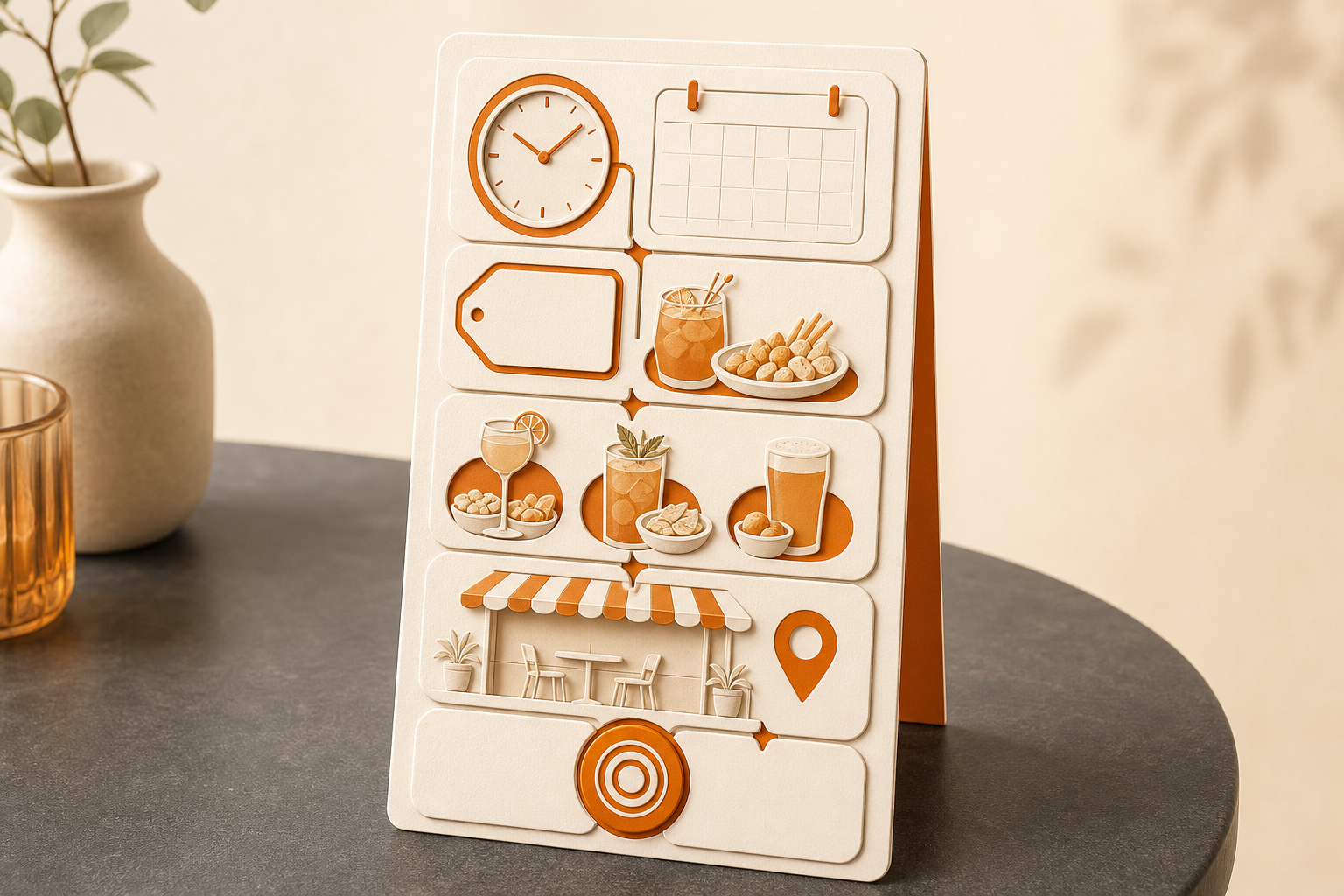
The ad should show the complete decision, not just a catchy name. “Happy hour tonight” is a reminder. “Weekdays, 4–6 p.m.: $1 off select drafts plus discounted shareables” gives a potential guest enough information to act.
| Include | Why it matters | Example format |
|---|---|---|
| Days and hours | Removes uncertainty | Monday–Friday, 4–6 p.m. |
| Exact offer | Gives a reason to choose your venue | $1 off select drafts; select shareables available |
| Eligible items | Prevents disappointment at the bar | House wine, select drafts, listed appetizers |
| Location details | Helps a nearby guest decide fast | Patio bar only; dine-in only; Downtown Greenville |
| A next action | Turns interest into an observable action | Show this screen, scan the QR code, book a table |
Keep the core wording consistent across channels. If social media says one thing, your host stand says another, and the menu has different hours, guests and staff both lose confidence.
A useful test is to read the promotion from a guest’s perspective. Could someone who has never visited understand it without calling? To see the kind of details local customers use when comparing offers, see how deal-seekers compare nearby specials.
Use a channel plan, not one post
One Instagram post can support happy hour, but it should not carry the whole promotion. Use each channel for the job it does best: discovery, reminder, conversion, or reinforcement.
Make local discovery accurate first
Start with places where someone searches when deciding where to go. Keep your Google Business Profile, website, menu, business hours, address, and booking information current. Google allows business owners to publish updates, offers, and event details on Search and Maps, but its post policy says regulated-industry posts must not include content about regulated products, including alcohol. Use the profile to keep essential venue information current and review the current Google Business Profile post guidance before publishing any alcohol-related promotion.
For a Greenville-focused channel, add your verified deal to a local happy-hour discovery listing. A listing works best when it matches the offer guests will receive: same schedule, same terms, same food-and-drink details, and prompt updates when anything changes.
Use social media for timely reminders
Social posts are most useful when they make the offer feel current. Rather than repeating a generic graphic every day, rotate practical angles:
- A short weekly post with the regular days, hours, and food options.
- A same-day reminder before the quiet period begins.
- A staff-led post showing one featured food item or the atmosphere guests can expect.
- A story or short video that directs people to the day’s complete terms.
Every post still needs a clear action. Choose one: view the menu, save the offer, book, call, walk in before a stated time, or show a code. Avoid using a single post to ask people to follow, comment, tag friends, visit a website, and make a reservation all at once.
Use email and text for opt-in reminders
Email can reinforce a regular weekly rhythm. A simple message with the week’s happy-hour details, a food photo, and one button is usually easier to understand than a crowded newsletter. In the United States, commercial email must comply with CAN-SPAM requirements, including accurate sender information, a valid postal address, a working opt-out method, and prompt handling of opt-out requests. Review the FTC’s CAN-SPAM compliance guide before sending promotional emails.
Text messages can be useful for time-sensitive offers, but they need more care. Send marketing texts only through a program built around appropriate consent and a clear way to stop messages. The FCC recognizes reply-text opt-outs as a reasonable way for consumers to revoke consent and has specific requirements when a text program does not support replies. See the FCC’s consent-revocation order and have your process reviewed for your exact program.
Let the venue do some of the advertising
People already in the building are your warmest audience for a future visit. Put one compact happy-hour message where it helps staff and guests:
- A table tent or coaster with a QR code to the full terms.
- A small host-stand sign for guests arriving before the offer starts.
- A menu insert that clearly separates happy-hour items from the regular menu.
- A staff script such as: “Our weekday happy hour runs until 6 p.m.; the shareables menu is right here.”
Keep the QR destination current. A code that opens an expired offer is worse than no code because it wastes a high-intent moment.
Give every promotion a measurable call to action
Do not measure happy-hour advertising only by reach, likes, or views. Those can help explain awareness, but they do not show whether a promotion changed visits or sales.
Choose one measurable action for each channel:
| Channel | Primary call to action | What to record |
|---|---|---|
| Local listing | View details or directions | Listing views, saves, direction requests |
| Social post | Show a code or scan a QR code | Code redemptions or QR scans |
| View this week’s menu | Clicks, reservations, tracked visits | |
| Text alert | Redeem today’s offer | Replies, redemptions, unsubscribes |
| Table tent | Scan for next visit | QR scans and return-offer use |
Use a different code or QR destination for each channel. For example, MAP, SOCIAL, and EMAIL can all unlock the same eligible food add-on, but they reveal where the guest found the promotion. Keep the reward simple and compliant.
Run a 14-day happy-hour advertising plan
A short launch window gives you enough time to find errors before treating the campaign as a permanent program.
| Timing | Action |
|---|---|
| Days 1–2 | Finalize offer terms, staff instructions, baseline sales data, and legal review. |
| Days 3–4 | Update discovery listings, website details, Google Business Profile essentials, and in-venue materials. |
| Days 5–7 | Publish the weekly social post and prepare one same-day reminder. |
| Days 8–10 | Send an opt-in email or text reminder with one tracked call to action. |
| Days 11–12 | Check staff feedback: guest questions, redemption problems, stock issues, and unclear terms. |
| Days 13–14 | Compare performance with the same days and time period before the campaign. Keep, revise, or stop one element at a time. |
For Greenville venues that need a dedicated place for current specials, Happy Hour Flower offers a free route to get on the map, with paid options for additional visibility and promotion tools. Review the current venue plan options before choosing a plan.
Measure visits and revenue, not likes
Set a baseline before declaring the campaign successful. Compare the same days and hours before and after the promotion, while noting weather, major events, staffing changes, and unusual closures that could affect the result.
Track a small scorecard:
- Happy-hour covers or transactions
- Happy-hour sales
- Average check during the promotion window
- Food attachment rate: how often a happy-hour check includes food
- Offer redemptions by code or QR source
- New email or text subscribers, plus opt-outs
- Listing views, saves, or directions as supporting indicators
If traffic rises but average check falls sharply, the offer may be attracting low-margin orders without enough food or return business. If a channel gets attention but no redemptions, improve the offer clarity or the next step before adding budget.
The goal is not to make every slow hour crowded. It is to create a repeatable promotion that is clear to guests, manageable for staff, compliant for the venue, and measurable enough to improve.
Frequently asked questions
What is the fastest way to advertise happy hour?
Start by publishing one precise, verified offer where nearby guests can discover it: your website or menu, local listings, and a same-day social reminder. Include the days, hours, eligible items, location, and one action to take. Then use a trackable code or QR scan to learn what brings people in.
What should a happy-hour advertisement include?
Include the offer, the exact schedule, eligible items, service restrictions, venue location, and a clear next step. If food is part of the value proposition, show it prominently. In Greenville and elsewhere, review alcohol-advertising rules before publishing price-led language.
Should a bar use paid social ads for happy hour?
Paid promotion can be worth testing after the offer, tracking, audience settings, and platform-policy review are in place. Start with a small, time-limited test aimed at a measurable action. Do not increase spend based only on views or engagement.
How often should a venue promote happy hour?
Use a dependable weekly rhythm for a stable offer, plus a same-day reminder when it is useful. Update every channel immediately when hours, terms, availability, or eligible items change. Consistency matters more than posting constantly.
Related articles

Happy Hour Promotion Metrics: What to Track and Why
Track impressions, listing views, saves, directions, clicks, calls, and redemptions to see whether a happy hour promotion creates real visit intent.

Where to Find Lunch Specials in Greenville, SC
Find Greenville lunch specials worth checking today, compare deal types, and use a quick method to confirm prices, hours, and availability before lunch.

Google Maps vs. Yelp for Finding Happy Hour Deals
Compare Google Maps and Yelp for happy hour: what each can tell you, what they cannot, and how to verify today’s deal before you go.